
Monday, 11:00am
20 July 2026
No history to rule them all

Sandra Maxa
Mark Sanders
various designers
Buddy Esquire
PHASE 2
April Greiman
Wolfgang Weingart
Hassan Massoudy
Herb Lubalin
Design education
Design history
Reviews
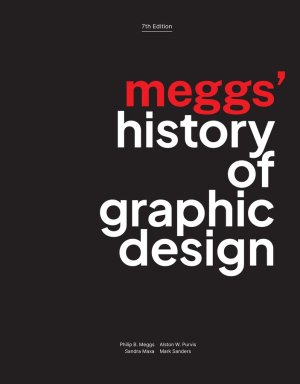
Meggs’ History of Graphic Design, Seventh Edition
by Philip B. Meggs, Alston W. Purvis, Sandra Maxa, and Mark Sanders, Wiley, $104.95, £80.00. Designed by Sandra Maxa and Mark Sanders. Reviewed by Aggie Toppins
In 1983, Philip B. Meggs published the first comprehensive survey of graphic design. He called it A History of Graphic Design because he believed his interpretation was only one of many possibilities. Nevertheless, it became perhaps the most popular textbook on the subject, with six more editions, four of which were published posthumously. (Meggs died in 2002 aged 60.) The most recent release, edited and thoughtfully designed by Sandra Maxa and Mark Sanders, presents a substantial reorganisation. In place of Meggs’s sprawling chronology, the contents are now grouped into themes. Chapters on writing, representing and exalting, for example, aim to inspire new connections from within this old text.
I have often wondered why Meggs did not title his book A Chronicle of Visual Communication. Unlike a true history, which makes an argument based on evidence, this book is a reference volume that traces the origins of the modern profession called graphic design to ancient precedents. The seventh edition retains Meggs’s descriptive approach. It presents many facts and, through its arrangement, tasks readers with forming their own analyses. In our time of algorithms and machine ‘hallucinations’, a curated collection of reliable information is useful. The question for those who teach with this book, however, is how to help students make meaning from so much information. Two bibliographies list hundreds of secondary sources – books, articles and websites where readers can continue their studies. Unfortunately, as in previous editions, the seventh lacks an introduction that situates the book within this literature. There is a brief preface, but it does not name a critical position.
In a 1994 lecture presented in Cholula, Mexico, Meggs lamented that contractual limitations caused him to reduce the material in the first edition to topics that had an evolutionary link to graphic design in the United States. He, and later Alston W. Purvis, expanded the scope in subsequent editions. Even so, A History has been widely criticised for venerating mostly white, male designers. The seventh edition is the most inclusive version yet. The editors have heeded recent calls to diversify the canon, a term that, despite its buzzword status, stands for those exemplary designers whose work set the standards of excellence in the field. It would be facile to align this canon entirely with Meggs’ History, but his emphasis on certain pivotal figures was unquestionably influential. In the seventh edition, readers will find examples by Angel de Cora, Buddy Esquire and Cheryl D. Miller. They will read about Journal Safar, as well as Saki Mafundikwa’s research on African typography. To make room for these inclusions, the editors had to omit some things. There are now fewer interactive examples. Marie Neurath (see Eye 73), mentioned only by her birth name (Reidermeister), remains in her husband Otto’s shadow. Tomoko Miho (see Eye 105) is still not in this book. To be sure, no history can cover everything and everyone. There is simply too much past for any one history. A complete chronicle would be impossibly broad and unreadable. Still, it would be useful to know why some examples made the cut and others did not. Historians often put productive limitations on the scope of their study. Meggs’ History could be more transparent about where its limits lie.
Like Meggs, Maxa and Sanders are not historians. They are designers and educators who were graduate students at Virginia Commonwealth University when Meggs taught there. Like many who knew Meggs, they were fond of the man. In the past, Maxa and Sanders worked with Wiley to update Typographic Design: Form and Communication, first published by Meggs and Rob Carter in 1993. But taking on Meggs’ History – a book which is as beloved as it is disliked – had to be a daunting task. Maxa and Sanders treated the revision like a design project. They cut it to pieces and put it back together again. They kept some of Meggs’s writing, but wove their own insights with his. They reused many images, but they designed the layouts so that small pictures would appear on the pages where they are mentioned in the text and then reappear in larger form on ‘gallery’ spreads. To test the book, they empanelled an advisory board of designers, educators and historians who reviewed it. The result, like Meggs’s original, offers a way of looking at design in the past. It is not the only way.
Meggs established the field of graphic design history, and his book is notable for tracing changes in form over time. He took methodological cues from media theory and traditional art history (although art historians today use many critical lenses, traditional art history foregrounded artistic ‘masters’ and their great works). He did not use a political or social history lens. Meggs had little to say about labour, perhaps because in 1983, Meggs was one of many professionals seeking to distance graphic design from the working-class trades that preceded it. And yet, just before the dawn of desktop publishing, there were anxieties about the computer's impact on the field that may sound familiar today. With the rise of ‘artificial intelligence’, questions about labour are among the most urgent and vexing. Is another art history of graphic design what we really need right now?
Maxa and Sanders understood that students, who are likely the book’s primary readers, do not always respond to dense texts. Their attentive restructuring continues the original author’s traditionalist legacy, although the seventh edition is more diverse, thematic and less idolatrous of designers and their works. It is still a form-based approach, but now it encourages readers to compare and contrast works from different places and periods of time. It does not answer every question. It does not cover every angle. If designers and design educators truly want to trouble the canon, as so much recent discourse has suggested, they should read (and teach) more widely than Meggs’ History.
Aggie Toppins, associate professor, communication design, Washington University in St Louis
Meggs’ History. Cover design: Mark Sanders.
Top. Spread from Meggs’ History showing work by Herb Lubalin, Hassan Massoudy, Wolfgang Weingart, April Greiman, PHASE 2 and Buddy Esquire.
Eye is the world’s most beautiful and collectable graphic design journal, published for professional designers, students and anyone interested in critical, informed writing about graphic design and visual culture. It is available from all good design bookshops and online at the Eye shop, where you can buy subscriptions and single issues