
Summer 2026
Fast-forward to the future
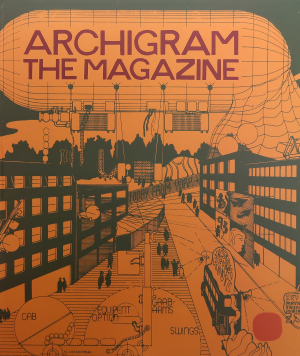
Archigram: The Magazine
Reader’s guide co-edited by Thomas Evans and Steve Kroeter. Design: Julia Ma and Miko McGinty, Miko McGinty Inc.. D.A.P. and Designers & Books, £170. Reviewed by Rick Poynor
The reputation of Archigram, a kind of experimental architectural think tank, founded in London in 1961, grows by the year. Not bad for a group of ‘paper architect’ provocateurs who were prolific on the drawing board but rarely built actual buildings. In 2019, Archigram’s entire archive was acquired by the M+ Museum in Hong Kong for £1.8 million. Copies of the nine (and a half) magazines they self-published from 1961 to 1974 to disseminate their controversial ideas go for massive sums today. While working on this review, I chanced upon a copy of Archigram 5 (1964) priced at £850 in an art bookshop. 1250 copies were printed of that issue, but most edition sizes are unknown. Copies became exceedingly rare and difficult to see.
So it was exciting news when Steve Kroeter’s Designers & Books and D.A.P. announced a Kickstarter project to publish facsimile editions of every issue. I should declare an interest and say that I signed up as a backer – as did several familiar names from graphic design, who can be found in the published backers list. The group’s techno-charged space-age proposals for Plug-in Cities, Instant Cities and, most futuristic and jaw-dropping of all, Walking Cities still look remarkable, and so do the ever-shifting shapes and restless graphic inventions of the magazine that presented them.
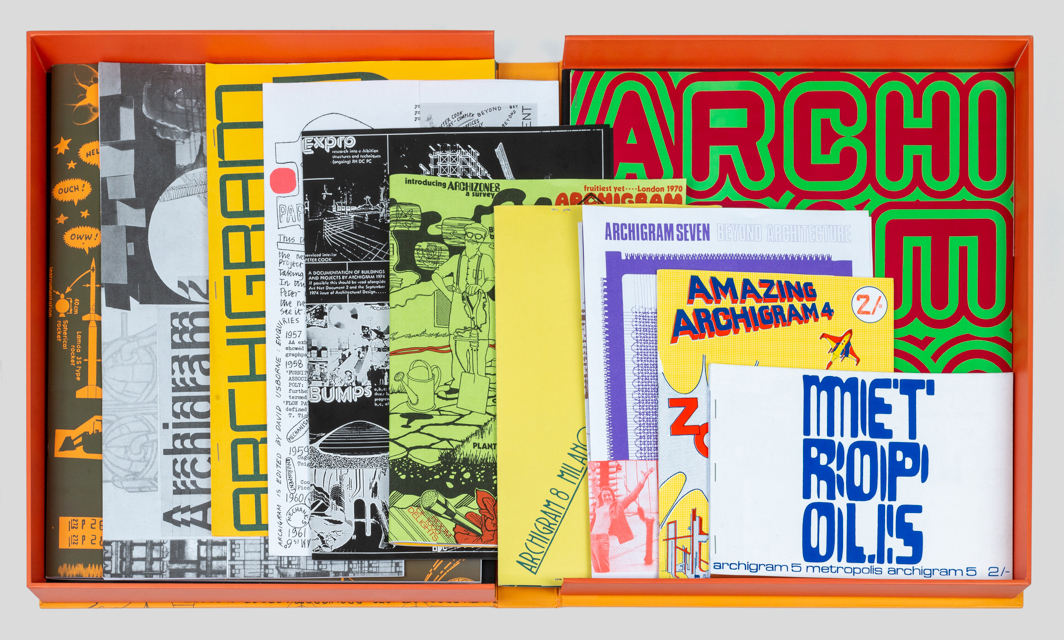
The project comes in a super-sized orange box ...
Cover of Archigram: The Magazine, featuring a drawing by Archigram member Peter Cook. Top. The open box, showing nine issues of Archigram, the final ‘half’ issue and the introductory booklet.
Rick Poynor, writer, Eye founder, Professor Emeritus, University of Reading
Read the full version in Eye no. 110 vol. 28, 2026
Eye is the world’s most beautiful and collectable graphic design journal, published for professional designers, students and anyone interested in critical, informed writing about graphic design and visual culture. It is available from all good design bookshops and online at the Eye shop, where you can buy subscriptions and single issues.