
Spring 2025
Films on tap
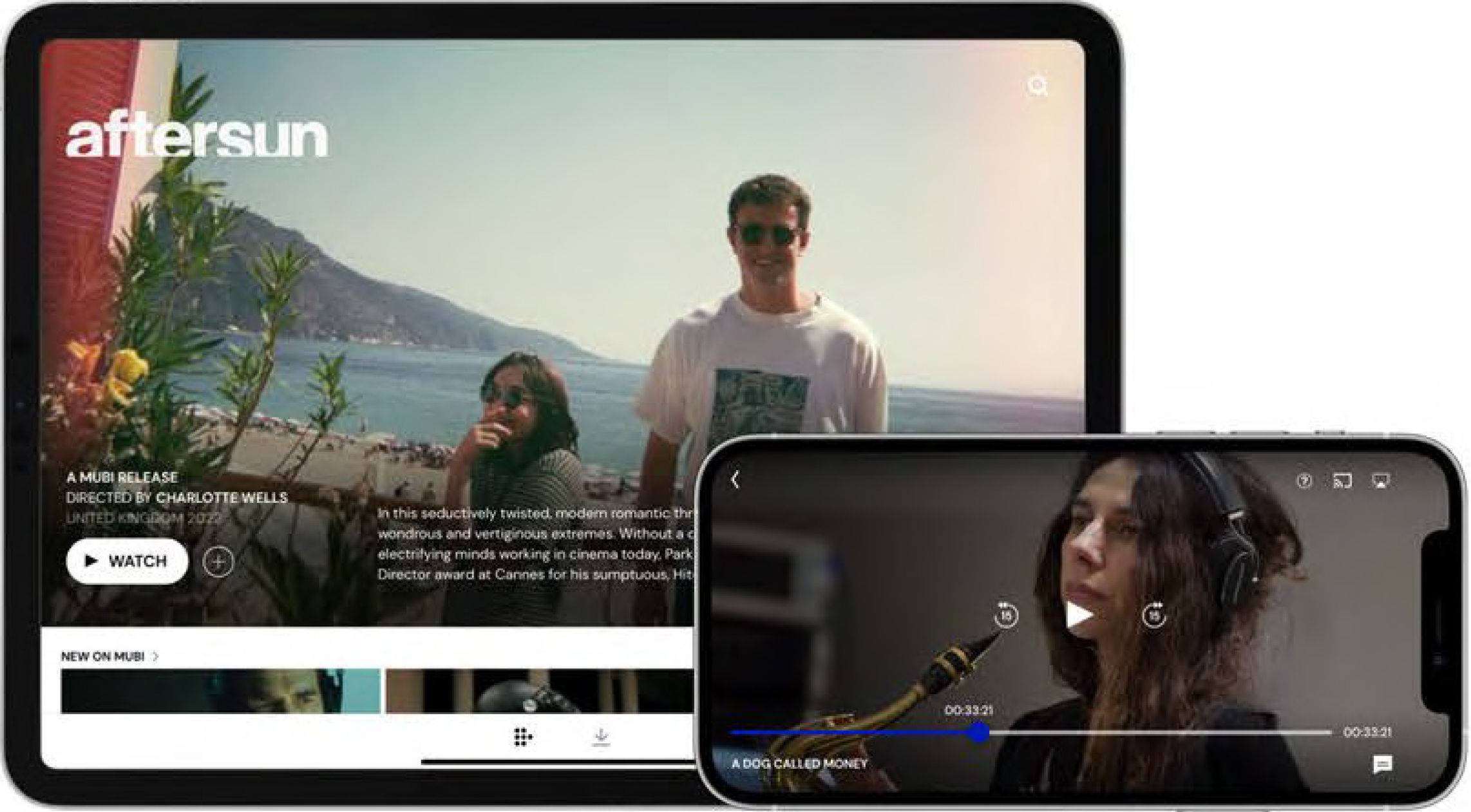
Founded in 2007 by Efe Cakarel, Mubi favours editorial design over marketing conventions to reach twenty million subscribers in 190 countries. By John L. Walters
The first film Efe Cakarel licensed for Mubi was La Antena. Made by Argentine director Esteban Sapir in 2007, this hallucinatory, almost silent film evokes early cinema, with enormous surtitles that sometimes fill the screen, archly staged and shot in dusty, distressed monochrome. It features the meek, voiceless inhabitants of a snowbound city and a Berlusconi-like villain overlord (‘Mr TV’) whose spiral branding affects every aspect of their lives. Eighteen years on, Cakarel vividly recalls his trip to Buenos Aires to collect a hard drive copy of the film that would hit the start button on his streaming service.
The founder’s love of cinema stems from his happy childhood growing up in İzmir, a small city on the west coast of Türkiye. His mother would take him to a local theatre that showed ‘beautiful independent films’, foreign-language films – he recalls falling in love with Cinema Paradiso, which celebrates a celluloid culture that had already died. Cakarel looks back on his early cinematic experiences with similar feelings.
Top. Mubi experienced on tablets and smartphones. The streaming service declares: ‘We believe cinema should be viewed on screens of all shapes and sizes.’
Digital
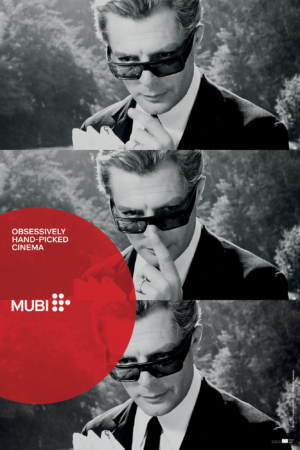
‘triptych’ posters for Mubi’s film programming use three frames
from a classic movie, in this case Federico Fellini’s 8½,
starring Marcello Mastroianni. Mubi creative director: Pablo Martín.
‘Sadly, those cinemas no longer exist in my city. There is no-one focused on showing the kinds of films I want to watch. The younger generation is increasingly not exposed to great cinema and there are less and less venues to experience it. This happened over a couple of decades … we came to a world where nobody really stands for anything and everybody’s trying to increase engagement and views, but nobody’s focused on great cinema and curation.’ For Cakarel, a former Goldman Sachs banker whose background is in computer science and business management, this was not cause for regret but a call to action. He realised that the consumer experience was shifting towards TCP / IP protocol – watching videos online.
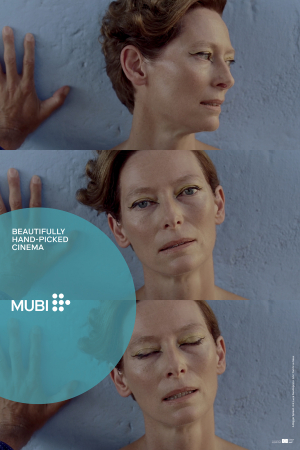
Digital ‘triptych’ poster for Luca Guadagnino’s A Bigger Splash starring Tilda Swinton. Mubi creative director: Pablo Martín.
Most
current streaming services developed or evolved from companies that
began with other business models, for example mail order DVD
companies (Netflix and LoveFilm, swallowed by Prime), distributors
(Canal+), film organisations (BFI), arthouse chains (Curzon) and
reissue specialists (Criterion). Mubi was digital-first.
Screens of all shapes and sizes
From the outset it felt more like a rolling film festival, or a repertory cinema. For more than eight years, from 2012 to May 2020, the company debuted a new film that members could watch for 30 days. This way, Cakarel could negotiate limited (hence more affordable) rights from the films’ owners and keep Mubi’s audience entertained with a steady supply of fresh titles.
‘Streaming made cinema more convenient and accessible,’ he says, sipping coffee at Marchesi in London, in the company of Mubi’s creative director Pablo Martín (formerly half of Atlas, see Eye 95). ‘If you live in Bogota and you are into Ozu, there is no way you can watch Tokyo Story anywhere except Mubi. Streaming opened up a huge world of great cinema.’
Mubi’s reach is global, viewed ‘on screens of all shapes and sizes’, with twenty million subscribers in 190 countries. There are fifteen offices worldwide, each with local film curators. In all, there are around 400 employees. Other products and services have mushroomed: DVDs and Blu-Rays; merchandise; the erudite Mubi podcast presented by Rico Gagliano; Mubi Fests in different cities; the Mubi Go scheme to encourage real-time cinema-going.
Yet there is a kind of generosity about the way Mubi presents each film. When you choose a movie to watch late at night, the 300-character descriptions feel more like something a friend would tell you. The choice and crop of film still, the typographically ingenious titles and trailers, the sheer style of its posters are informed by the movies’ contents rather than marketing lore. Yet of course there is no better way to ‘sell’ a movie.
‘The people who work here love movies,’ says vice president of publishing Daniel Kasman. ‘This idea of starting a platform to share and unite audiences and good movies, we all believe that. So when the team’s writing these 300-character things, how do we get you excited about this? What do you need to know about this movie? How would I recommend it to you to get you excited? Human beings chose the film and wrote about the film. Human beings are going to watch the film, so why would anyone have a robot automatically do this?’
Kasman, whose background was in academia, was one of Mubi’s earliest employees (‘number seven, I think’) and the first with a curatorial role.
‘Efe had a vision and amazing design sense,’ says Kasman, ‘but no-one was setting the curatorial line other than “quality cinema”, which sounds nice, but what does that mean? I chose every film, programmed every film we showed for the first four years or so, and then slowly we have been able to build a programming team.’ Early on, Kasman recognised the need for Mubi to have an editorial element that could ‘explore, advocate and contextualise’ what they screened.
‘For a lot of these films, the audience needs to know more about them, the world they come from, the film-maker who makes them, the context, the relevancy. [We are] building a world around these films, particularly independent films, international films, older films, and that can only benefit the movies … and make the platform richer.’
Kasman resists the notion of the movie as a consumer object: ‘It’s a culture and a community that we try to unite globally through the platform. The editorial weaves between the films and the audience in this way.
‘It’s not just what’s in the multiplex … it’s not just what’s English language. It’s a huge, beautiful world out there and we need advocates and connectors to make the audience aware these things exist.’
The online Notebook has featured good writing from the start, notably Adrian Curry’s popular column about the design of film posters. Kasman says: ‘In 2007 we were writing about films we couldn’t show. Now we can (mostly) show the films we believe in.’
One of several digital assets for the Mubi Podcast, 2023. Design: Spin.

FROM START-UP TO MAJOR PLAYER
The Mubi service is rooted in the digital, in service design, UX, and editorial design, guiding ‘film lovers searching, lost or adrift in an overwhelming sea of content’. The logo’s seven dots represents cinema’s place as the ‘seventh art’. The other six are architecture, sculpture, painting, music, poetry and performance (or dance). The current form of the logo was designed by Tony Brook’s company Spin (see Eye 86) in 2018, and Cakarel and Martín see no reason to change it. Spin’s thorough overhaul of the identity included the typeface choice of Norm’s LL Riforma (Lineto), now deployed throughout the branding, and rotating the logo through 180 degrees. ‘The Mubi logo will never change,’ declares Cakarel. ‘Not in ten years, not in 50 years. The only debate we have is: when can we start using the dots without the type?’
One task Mubi sets its designers is to build identities for films. ‘Sometimes we buy a film that already has an identity, so we “Mubify” it,’ says Martín. ‘We’ll create posters, all the social media promotion, all the assets that marketing will require from us. And there will be every video asset required for promotion – from a teaser trailer and “coming soon”, to a main trailer and clips from bigger releases, plus a huge number of assets –all in eight languages.’ These are: English, French, German, Italian, Dutch, Latin American Spanish, Brazilian Portuguese and Turkish.
Mubi has become more than a platform, since it now acquires, finances and produces movies, with increasing commercial and critical success in its journey from digital start-up to Hollywood player. Recent Mubi releases include Aftersun, The Substance, Luca Guadagnino’s Queer, Sofia Coppola’s Priscilla, Park Chan-wook’s Decision to Leave and Céline Sciamma’s Petite Maman.
Yet the design requires a certain humility, a coolness: how else could you incorporate movies as disparate as Grand Theft Hamlet, Mackendrick’s The Man in the White Suit, Kieślowski’s Three Colors trilogy and The Second Act, an elliptical, slyly critical film about a near future in which movies are made by Artificial Intelligence. Seasons dedicated to film-makers such as Jacques Tati are both cine-literate and seductive.
‘Design is important,’ says Cakarel. ‘Typically distributors, studios would focus on making the film as commercially appealing as possible. Everybody’s trying to sell. Our starting point is not commercial, but to do something great. Of course we want it to also be attractive and appeal and find its audience, but it’s a design-led process. That’s why a Mubi poster looks different from a major studio film poster. Its typography, its layout, it’s how we do what we do.’
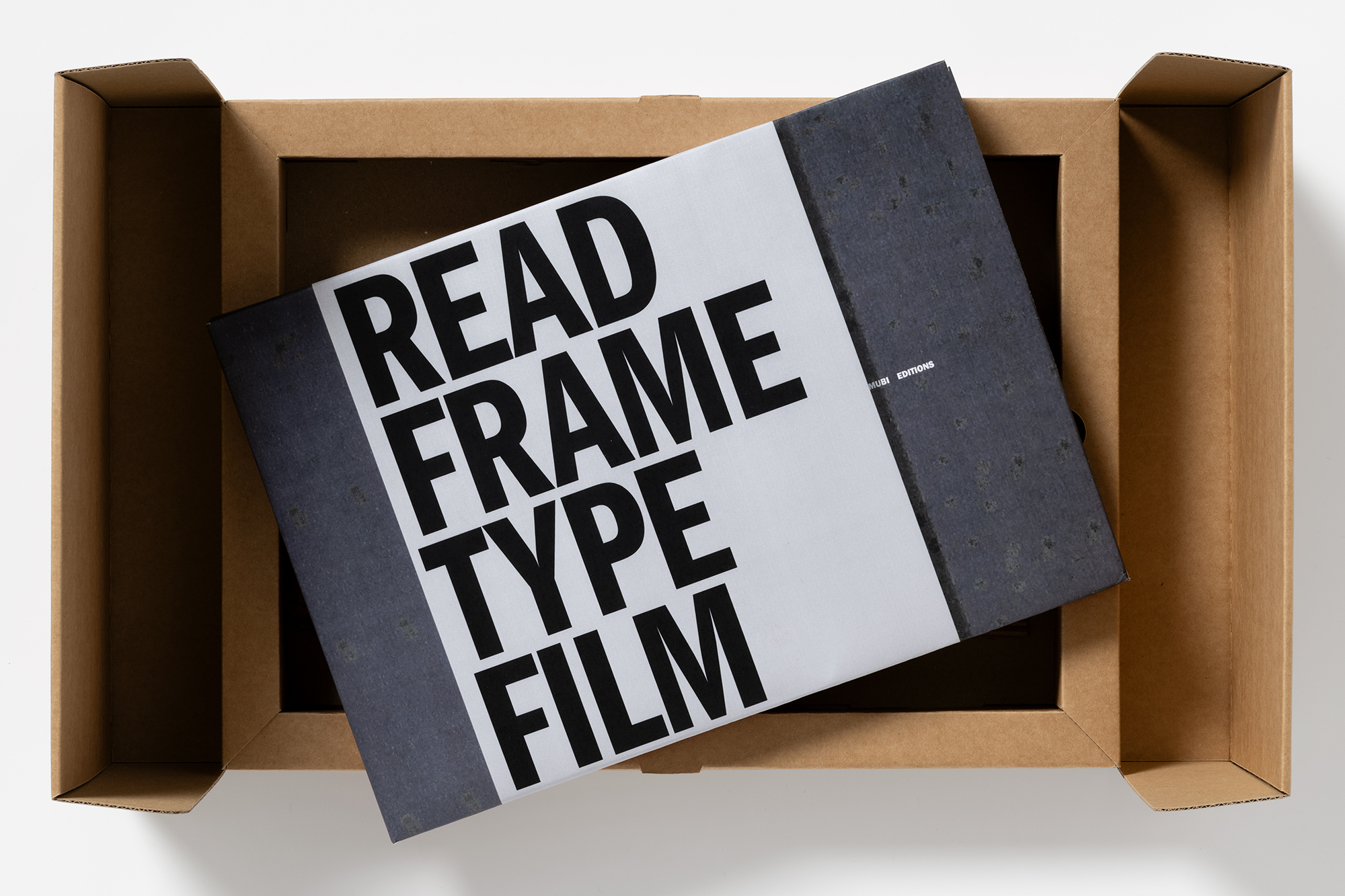
This year the company is launching Mubi Editions, books about the cinema, in collaboration with Centre Pompidou in Paris. The first title is Read Frame Type Film, which explores the use of text in film. Designed by SpMillot in Paris, the book is based on ‘TypoFilm’, a research project initiated at Pompidou in 2020 and is authored by Enrico Camporesi, Catherine de Smet and Philippe Millot, with a foreword by Robin Kinross.
Kasman’s ambitions for the publishing arm include direct collaborations with film-makers. ‘We would like to make something unique in print they wouldn’t otherwise do. So many [of them] have the capacity to do artwork outside of the moving image and we would like to give them the opportunity to do something on the printed page.
‘We’re living in this fast-paced digital age that seems to forget everything that happened yesterday. There are so many good things that could be brought to life. There are films by Alfred Hitchcock or Fritz Lang that had completed scripts, sitting in academic archives – but printing an unmade screenplay, a film you need to imagine in your head, what would that look like in a book form?’
Cakarel’s long-held ambition to run bricks-and-mortar movie theatres will eventually bear fruit in the form of a new, purpose-built four-screen cinema in Mexico City, designed by Milanese architecture practice Armature Globale. The design features a shell-like exterior that can function as an additional screen.
Cakarel pushes back at any suggestion that Mubi serves a ‘niche’ audience of twenty million ‘arthouse’ cinema-goers. ‘The love for film is universal,’ he says, almost thumping the table. It’s not niche. Great film is for everyone and this is what I’m fighting for. I’ve stopped saying “independent film” – it’s just great cinema. Christopher Nolan belongs to Mubi because [he makes] great cinema. Yes, it’s as big as it gets. The storytelling, the production, the performance, the vision, the lighting. So we are very ambitious. We are not about art house. So no, it’s not a niche and it’s very big.’
Cover of Notebook issue 5 by John Wilson.
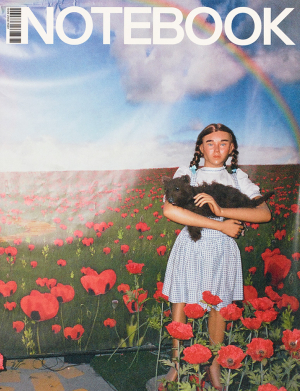
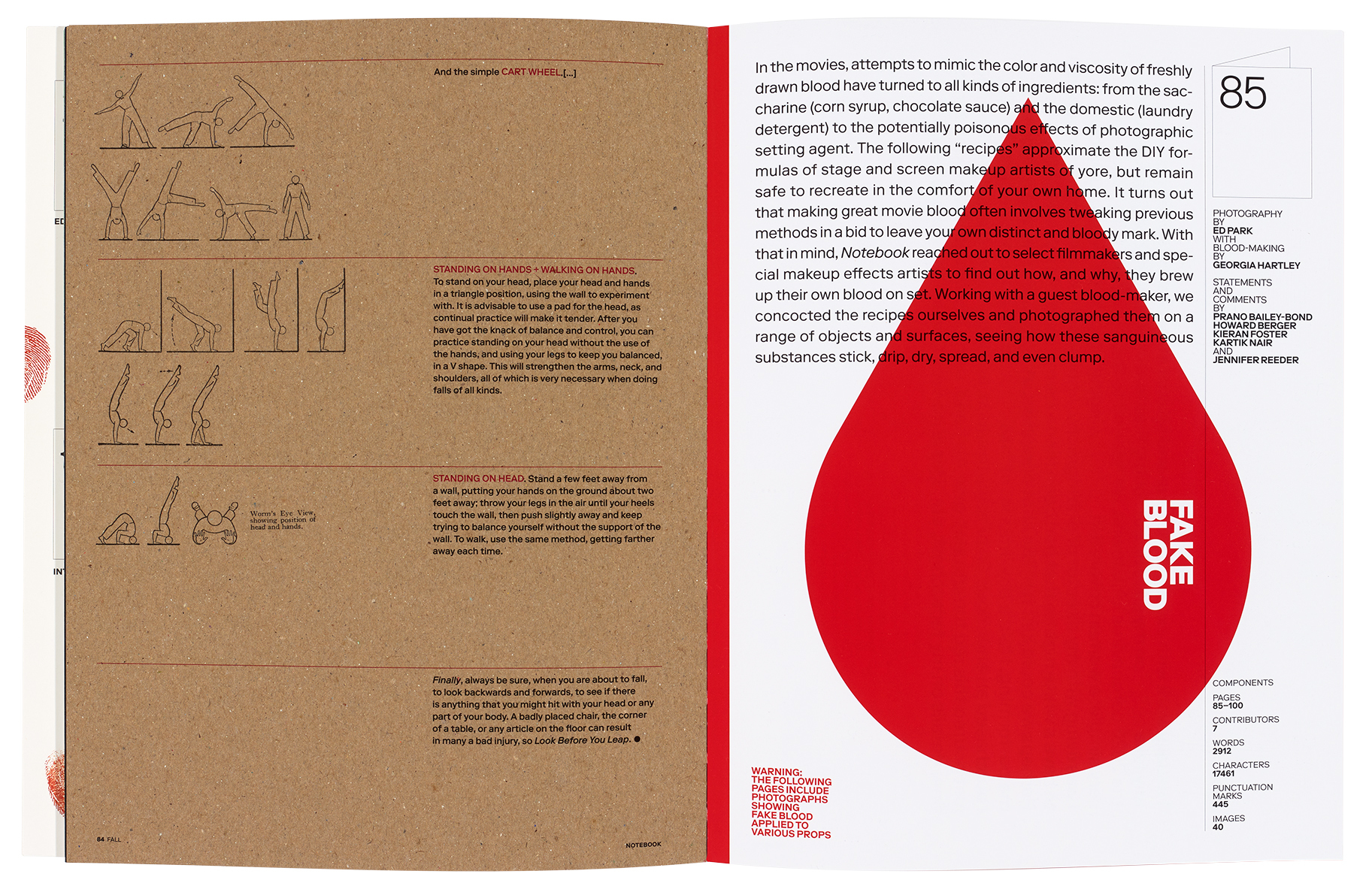
However, Notebook, the biannual indie print magazine launched in 2021 screams ‘niche’, if in the most stylish manner. Edited by Kasman, the mag is mailed to subscribers in a sturdy box, printed on several different sumptuous paper stocks and bound so it lies flat. Notebook largely eschews interviews and production stills in favour of essays, diagrams, manifestos, commissioned illustrations, photography and big type.
Yet the core of Mubi’s design is its curatorial perspective. How does the company define what makes a Mubi film? Is there a secret list somewhere that says which directors, which stars, which genres they would never screen?
‘Many people at the company have their own versions of that,’ says Kasman, ‘but context is everything. What’s different about programming from just putting films on a streaming service, is creating context and connections between things. It’s not about personal taste, it’s about building a world for the audience, and that world can include movies that are interesting but perhaps not very good. But “interesting” means worth your time. What’s beautiful about movies, unlike a book, is that it’s two hours and it’s gone. If it’s worth your time, we show it and we can put movies in conversation with one another.’
This is the ‘cinephile ecosystem’ that Mubi has created, and which its design serves. Kasman continues: ‘We’re building a world where if you want to watch a movie tonight, great. If you don’t want to watch a movie, you can read something about movies. If you don’t want to read, you can listen to a podcast. If you want to go out to the cinema, we can give you a free ticket through Mubi Go.’ Mubi’s landscape of sub-brands, products and spin-offs is now more extensive than anything La Antena’s villainous ‘Mr TV’ could dream of.
Cakarel says that his aim was always to ‘champion great cinema’, implicitly in the face of blandness and blind commerce. Somehow, Mubi’s curators, editors and designers keep this dream alive and evolving.
John L. Walters, editor of Eye, London
First published in Eye no. 107 vol. 27, 2025
Cover and box for Read Frame Type Film, 2025, designed by SpMillot, and the first book from Mubi Editions. By Enrico Camporesi, Catherine de Smet and Philippe Millot, with a foreword by Robin Kinross.
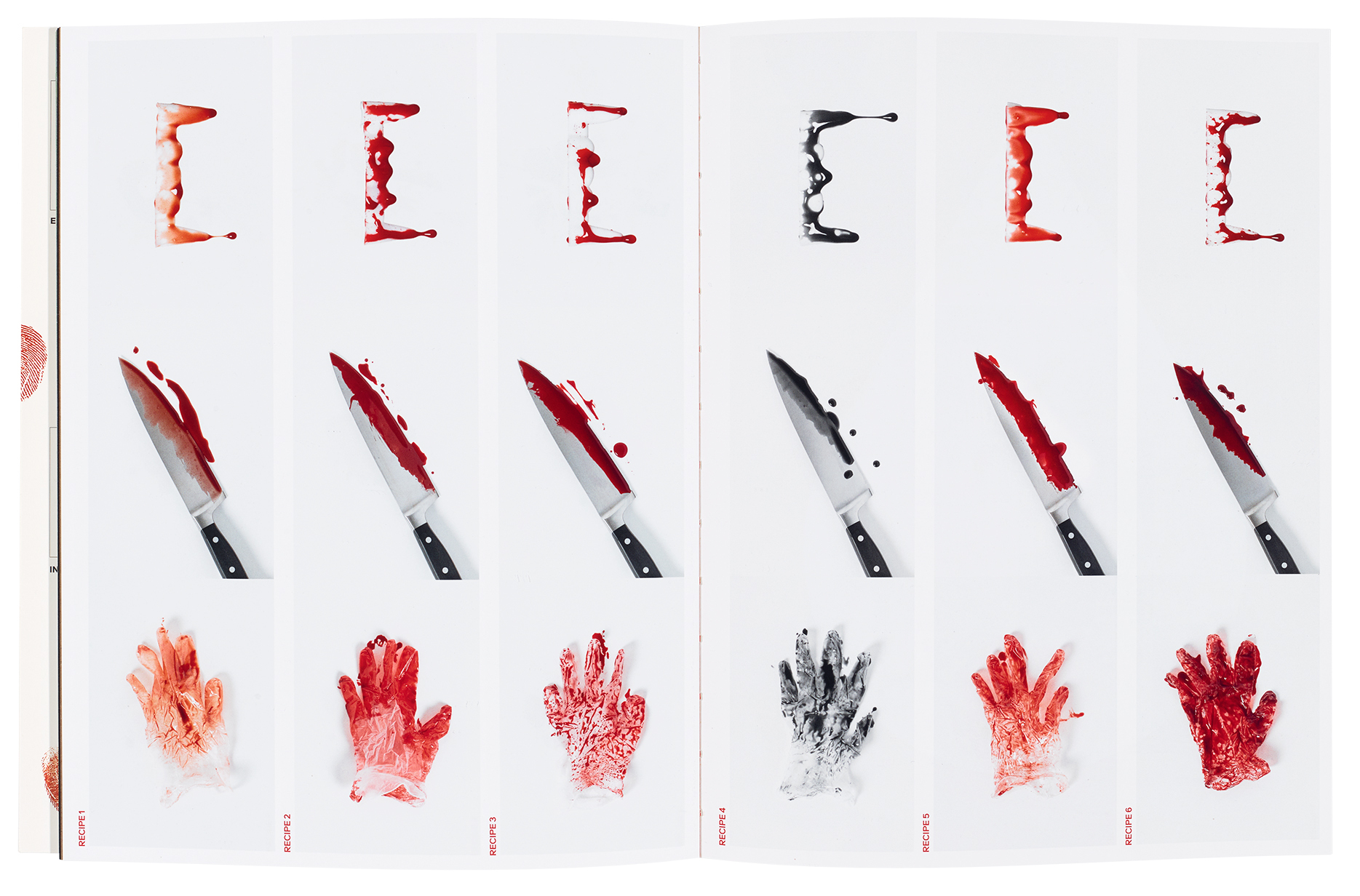
Spreads from Notebook no. 5. Creative director: Pablo Martín. The bloody images shown in the spread opposite from issue 5 are by Ed Park, the magazine’s official still life photographer, to accompany an article about fake blood.
Framed by a mag
Editor Daniel Kasman says that Notebook magazine ‘reboots itself with each issue’. Each is defiantly indifferent to current trends and explores a theme such as sound (no. 4) or childhood (6), with cine-literate writing about subjects that have included merchandise, theory, history and an old cinema in Bologna. Notebook highlights include a gatefold section about movies that feature Grand Central Terminal (2); a feature about sound effects made in a Foley studio (4); a sixteen-page section on gloss paper about fake blood, with photography by Ed Park (5) and an article about ‘de-aging’ technology. Regulars have included ‘things a filmmaker should know’ and scans of physical postcards mailed to Mubi’s London office.
There’s usually a gift, such as a ‘multiuse bag’ (3), a seven-inch vinyl disc (4), a cut-out card model designed by Ellie Sampson (5) of a 1970s special effects set-up from Alejandro Jodorowsky’s abandoned version of Frank Herbert’s Dune – even stickers (6). The forthcoming issue (7) includes a whole section ‘dedicated to the unfilmable’, and the postcards are to be replaced by ‘Exquisite Cinema’ in which readers send in photographs – nearly 300 submitted so far – that could be scenes from imaginary films. JLW
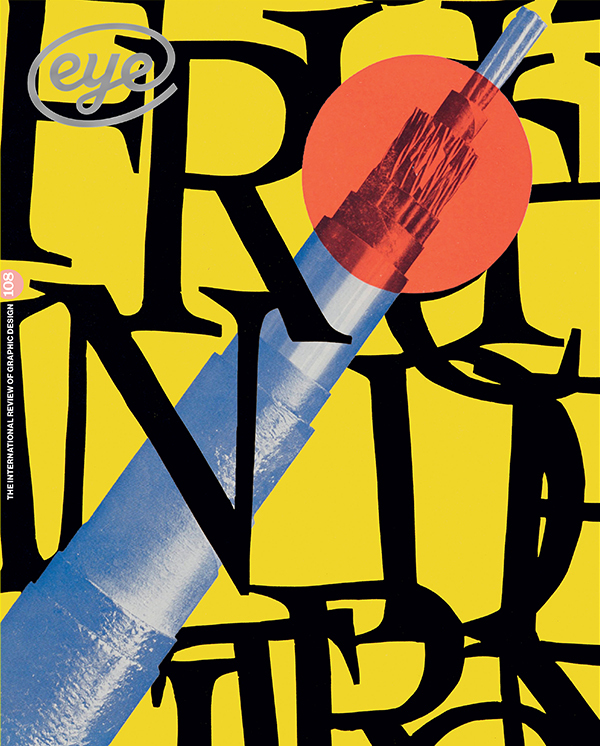
Eye is the world’s most beautiful and collectable graphic design journal, published for professional designers, students and anyone interested in critical, informed writing about graphic design and visual culture. It is available from all good design bookshops and online at the Eye shop, where you can buy subscriptions and single issues.